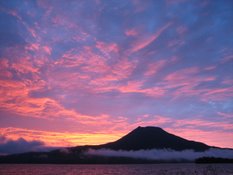
Here's another travel story from my diaries. This one's from my trip to Russia and Belarus on a Sophomore Year Study Abroad. Enjoy!
As someone once told me, "the afternoon already knows what the morning has no idea of," today I learned that God's plan is already established and we just need to trust and walk forward in it. I felt that feeling this morning when I arrived in Minsk, it was very similar to hanging out in populated place just coming back from an extended camping trip: no money, yet you're surviving and enjoying newness for free. I sat down on a park bench with all of my things and read a Bible for inspiration. I questioned my sincerity of loving my neighbor and leaving my nets for Christ. In terms of nuggets for the day, I had a whole mine full!
I next proceeded to change money and learned the lesson of reading fine print, I was charged 15% commision of travelers' checks. My first impression of the city outside the hectic train station: clean, quiet, and the buildings are grand, all-be-them Stalinist in architectural style [after being obliterated in WWII]. Minsk is 930 years old, but all history here says 1946.
My contact at the youth exchange camp didn't work on Saturdays as I found out arriving at Karl Marx 40 Street, but the receptionist was nice enough to let me drop my bags off and search for a hotel. I walked around town, saw the victory obelisk, and checked out the Hotel Sviclach, which was said by Lonely Planet to be nice and cheap. Price have gone up to $15/night and that would wear hard on my wallet at this point in my trip. I had read about the International Tourist Center of Youth and gave them a call. Through a bad connection, I thought I heard one room costs $2/night. Excellent! Little did I know of the trial that lay ahead of me in trying to find that cheap night's stay.
The guidebook was vague on directions. I struggled with my neck-high camping backpack and over-the-chest bookbag to negotiate the summer sweating streets towards the bus station. When I finally got there, I was first in line for the bus out of town in the direction of the Hostel. Unfortunately, I wasn't too seasoned in Belorussian bus jockeying tactics. When the bus arrive, I was trampled from behind by the veterans. As I tried to avoid bumping anyone with my two bags, they threw caution to the wind and marched aboard to get a window seat. When I finally got aboard, it was standing room only for me and my 50 pounds of gear. As we pulled away, two girls tried to make eyes with me and laughed either at me or their own silliness. I tried to ignore them but after a while it got annoying just trying to ignore them. The bus was crowded Russian-style [aka no personal space for Americans], the ticket lady was impatient with my lack of knowledge for my destination, and my bags were like buckets under a waterfall. Did I mention that it was about 90º today?
I asked a lady where the Minsk Sea stop was, and she said the next. Seeing no 14-story youth center in sight, I was confused and didn't prepare for my exit. I ended up missing it. Giggles in the background from the girls didn't soothe my boiling anxiety that my plans were on the wrong route. Sizzle. Pop! I signaled to get off at the next stop and threw down my stuff. Something had to be done.
I questioned the contents of my backpack and realized some things wouldn't thoroughly used. The trash can got a nice meal. Extra clothes, tapes, a Chicago Bulls shirt and other trinkets became a nice donation to the next passerby. I had no "ties to the flesh" and I found one net to leave today. I walked on without looking back and was relieved by my new freedom.
The country was pretty out there and I walked for a good hour before asking a couple where this mammoth hostel was. "On an entirely different road" the man said. I took a bus back, and would you believe it? the same annoying girls got on it later! Arrgh! I got off at my prior missed stop and asked around. "Way far off, you need a different bus". I decided to walk, they thought I was crazy. I thought I could truck it. I traversed some pretty lakes and got concrete directions from a nice man. Found the road and yup, started walking in the hot sun again. Just when I was fed up, I found the next bus stop and waited. The shadows were getting long. The bus came. Salvation at last!
I got off and the hotel really is some complex on a very beautiful lake. I entered, noticing the rows of washtubs and sinks lining the foyer. I asked for a room. They said, "we're closed." No place to stay, no hot water, and anyway the cost was like 500,000 Belorussian rubles for foreigners. I guess she didn't want me to stay there. Oh, one last perk for my visit, the last bus back to Minsk was the one that just dropped me off at the hotel.
So there I was without a place to stay, no ride back, and dusk coming in an hour or two. It was all I could do to fight back the tears for my lack of experience. I set off walking back on the road and "onward Christian soldiers" came to me. Some relief. I knew I had three options: take the electric train back, hitch, or sleep in the woods. I saw another couple's car off by the side of the road. They were at the forest's edge, hunting mushrooms. I told them my sob story.
There were receptive and didn't give a flat out answer. They just put my stuff in the trunk and we were off. Tamara and Ivan were mushroom hunters and nice to give me a ride. I had once read a book called, "Europe on 84¢ a day". It sang praises of traveling around Europe by hitch-hiking and staying in drivers' homes to reduce costs and build international relations. I tried to keep this conversation going in spite of my exhaustion. We arrived back in Minsk, and Ivan starting driving to hotels that he knew. We tried one on the outskirts, but it was hauntingly empty. Then we went back to Hotel Sviclach, they dropped me off and we shook hands farewell. They didn't leave. They wanted gas money. I guess in a town without taxis, the people are taxis and expect money. I gave them 100,000 BR and they were a little disappointed with my payment. Well, at least I was in a place.
I asked the hotel administrator of he had an available room, and the man he was talking to broke in to our conversation. He asked if I was a student, then said in English that he knew a place where I could stay for $2 a night. Like an answer to my prayers! We loaded his cargo and mine and set off talking.
Yevgeny worked at a music school, went to Paris, and has written several books. Now he's a pensioner adn works part-time at the hotel. He asked about me and my frown was turning upside down. he had some preconceived notions about Blacks in America as theives and I was glad to dispell some myths for him.
Finally, we arrived at a massive apartment complex and Yevgeny asked me to wait in the courtyard while he made arrangements with the babushka on the third floor. Zhenya steps out of her doorway to the staircase and looks me over with a concerned look that evaporates to a smile. She has an extra room and keeps a clean house. She fed me tea and even prepared a warm-water bath for me to clean away the sweat and frustration from my day. I feel blessed to have such accommodations close to Belarussian people. Thank you, thank you. Lord. Peace at last.
2.28.2007


2.19.2007
The snake and the field mouse
As promised, here's a story from my previous travels. It takes place in November, 1999.
There's something about realizing one's own mortality in a place, or furthermore on this Earth, that liberates him to try something exotic that he otherwise wouldn't. I realized this as a neophyte Peace Corps volunteer in Benin, West Africa.
I was training in Parakou, the gateway to the Sahel region in the North of the country. For two months, I had been negotiating for my future in the country; to have the right to pray for myself first before taking the mind-boggling anti-malarial drug should I contract the disease. Ironic, I never got sick a day while I was there. Still, I would go into town every two weeks for a phone call with the country director.
On this day, I had made a final decision: to transfer from Benin to another country's program yet to be determined. After two months of wrangling, I felt at peace. Although my time in Benin would be coming to an end, I finally felt free to enjoy my time there at it's fullest. I hung up the phone at the work station and walked outside to catch a Zemidjan. "Zeh" as they are affectionately called by locals, are scooter taxis that whisk Beninois around towns. I put on my casque, helmet, but left the visor up to catch the cool breeze as my zeh picked up speed on the western road out of Parakou.
With my mind free to reflect on the back of that scooter as I rode to the compound of my host family, I thought about my time there in Benin. How it was fraught with mental struggle to understand a new culture, included brief highlights of insight, laughter with host brothers, and fear of wild creatures and voodoo religion. The closer I got to home, the more I felt free of those limitations to my experience there.
By the time I arrived at the compound, I was like a released prisoner, given a second chance on my experience in Benin. So when there was an unusual amount of activity in the common area of the compound, I wasn't surprised that it was an extension of my new attitude. François, the teenage cousin of my host brothers, Muhammed and Fatau, was turning circles around them with what looked like a thick rope. When I got closer, we exchanged bonjou's and sa va's and I got a look at what François really had: a four-foot-long snake! It was dead, thank goodness. Muhammed and Fatau had catches of their own: two field mice.
The boys had been out working in the fields when they'd come upon this snake in the middle of ingesting a field mouse. Temporarily disabled in its gorging, the snake was vulnerable. François took his cutlass and chopped off that snake's head. What would they find not too deep in that snake's belly but another mouse. A double whammy!
Now don't think that these mice were finger length. In Africa, everything wild is so much bigger than what we imagine them to be from the comforts of our TV room in USA. These field mice were a full six inches long, not including the tail. Any catch of meat in this part of Africa was a special treat. My meals consisted mostly of pounded yams and potent soup base to dip it in. Certainly filling, but lacking in protein for sure. So when we had two kinds of fresh meat to eat, you can bet that was a treat!
Muhammed and another cousin prepared the fire, while François cleaned and gutted each creature. Fatau, about six years old with a belly rounded by vitamin deficiency, carried himself with a jollyful gait as he walked around the compound with the expectation to eat well that evening. I watched carefully has each boy set about to enjoy their feast.
How do you know when snake is boiled through? You don't. You just know how to cook something safely and then you apply to whatever mystery meat you find that day. As for field mice, Muhammed gutted them, skewered them, and then singed the hairs off them with the brightest of the flames on the fire. Then they set about cooking them shish-ke-bob style.
All the while I was savoring this moment of raw excitement and embracing of the surprises that the African earth could give up. This was the boys' feast, but I would certainly take a taste. What does snake taste like? How do you eat a mouse? Like itself, one bite at a time.
The meats were cooked and we boys sat around the dwindling light of the fire sinking our teeth into our dinner. The snake didn't break down without a dogfight in my molars. The mouse was moist, oily, and rich, almost like he came from the Nigerian soil to the East. I ate them without care for tomorrow. I ate them just savoring the experience of immersing myself in something so foreign and exotic to everything I'd grown up in, that nothing could hurt me. And nothing did. My subsequent visits to the latrine were regular and routine.
It's eight years later now. I look back on that experience with great treasure. My moment of eating in what Benin had to offer. In a month, I would board a jet plane for the States. In two, I would be in Jamaica. And another eating experience would begin.
2.10.2007
LA Times Travel & Adventure Show


Gilda and I went to the Long Beach Convention Center to hear Rick Steves give a talk on travel tips for a "backdoor experience". I've been a fan of Rick and his PBS show "Europe through the Back door" since 1998 when my college roommate and I would watch episodes and wonder who this guy with two first names was.
After watching so many episodes, listening to his podcast every week, and travelling to Berlin in 2003 using a few of his tips, we pretty much knew everything that he talked about. Still, there's something about seeing someone live and the interaction between audience and speaker that made it just as thrilling.
Rick emphasized that you should "psychologically immerse yourself in the culture and information of your host country" and "travel engaged in what you have an opportunity to learn". That means do your homework before you go and use local news sources while you're there.
After his 90 minute talk carried over into 120 minutes, we stayed after to get a book signed by him. His off camera persona is just as kind as his on camera one. Despite the 1000+ crowd thronging him, Rick still manages to keep things in perspective.
While my current financial situation makes our hoped trip to Turkey this year a murkier dream, I have come up with another idea to keep the travel theme to my blog more vibrant. Every week, I'd like to recount some travel story from my experience. It will help me to hone my travel writing skills and interest my readers. See you then!
1.31.2007
The Critic is "IN"
Gilda and I saw Freedom Writers tonight. I got in free with my school district paystub. With me paying for Gilda, it was like two for half price. Anywho, I was touched by the movie but felt it ended with more story to tell. Probably what anyone who's read the book before seeing the movie would say. I knew it would be hard to put a very prose-based book (a compendium of 150 students' diary entries that chronicle their 4 years together) onto the silver screen. Yet, producers Danny DeVito and company did a good job. The movie shows a lot more of the background drama of Erin Gruwell, teacher, with her husband and father not entirely appreciating the sacrifices that she's making for her students.
I give props to the movie for filming on location in Long Beach. Wilson High School looked like Jordan HS in North Long Beach, but the credits thanked LA Unified District. Some of the class procedures seemed to casual: like Gruwell inspecting her classroom just minutes before the first day bell was to ring, a supervisor waiting in the hallway to break up fights, and the entire campus going berserk instead of into lockdown when gangsters come to rough some guy up. But aside from the Hollywood drama designed to keep viewers' attention, I thought some of the scenes were very touching. Hearing the own stories of Holocaust stories always brings a tear to my eyes. Hillary Swank did a good job of sounding and looking like a white teacher not entirely down with street culture. Instead of being a teacher-as-hero movie, I think FW balanced the voices and scenes of students with teacher.
If you're a teacher, you've got one more day to see it free. But, in the end, I would pay money to see this movie just to see the views of Long Beach, stories of students' lives, and a positive message. This critic gives it *** 1/2 stars!
1.26.2007
Free Movie for Teachers
As I was subbing at my favorite school in Long Beach, Birney Elementary, I saw a notice from Erin Gruwell, teacher and editor of "The Freedom Writers Diaries", saying that AMC and Paramount Pictures are making the movie Freedom Writers available free to teacher for a week from Janauary 26-Feb 2. All you need is your k-12 school id or pay stub and ID. Go see the movie. I'll see it this weekend and maybe again at this rate!
Already seen it? Lemme know what you think. I have a feeling it'll be shaped by the typical Hollywood "hero teacher helps underpriviledged students" genre but I hope there's something in there that breaks the mold. The book was very honest about students' own lives in around the Long Beach of mid-90s.
Already seen it? Lemme know what you think. I have a feeling it'll be shaped by the typical Hollywood "hero teacher helps underpriviledged students" genre but I hope there's something in there that breaks the mold. The book was very honest about students' own lives in around the Long Beach of mid-90s.
1.19.2007
Oh no! A Backhoe!

A babbling brook snapped me out of my test prep study this morning. No, I haven't retreated to the San Bernadino mountains to study for my English teacher credential test. A water pipe burst underneath the alley behind my house. Dirty water was coming up out of every crevice with a connection down under.
I could hear Mel the Manager and Rob the guitarist (my neighbors) talking about the causes and implications. I figured they were on top of things and all the DWW (Department of Water Works) would have to do is shut something off. 5 hours later, I'm heading out to scope out the test site so I don't get lost and late tomorrow. They've got a few DWW trucks and utilities workers out there assessing the damage. Mel says I'll have to park on the street for a few days. Dwight, the utilities workers, corroborates Mel's story. Oh well, at least I got my car out before it was trapped.
I came back from my reconnaissance this evening to find a "road closed to thru traffic" sign at the front of the alley. "Oh good" I thought, "for the first time a sign like that doesn't apply to me because I'm not trying to weasel through, I live here." But a backhoe, dump truck, and yellow utilities truck blocked my passage to my parking spot. I had to park two blocks away.
As I ascended to my second floor apartment, the noise grew from the backhoe. 9, 10, 11 pm. They're still digging? Don't they know that I have a huge test tomorrow? Water Works waits for no one. At least I'm getting good alliteration practice out of their excavation escapade.
I stay resilient. I'll sleep with soothing music playing in my headphones to keep the exhaust and idle of the backhoe out of my ears.
1.18.2007
New Year, No Post

With New Year's resolutions, I've tried to be more disciplined in my time use. Unfortuantely for my dwindling blog reading audience, that means that I haven't updated my blog in almost 3 weeks.
I'm trying to simplify my life, have less distractions, and finish things that I start instead of starting too many things that I can't finish.
I continue to substitute teach in the local schools. Travelling to new sites each day gives me an inside perspective on the school system so that eventually I can get hired for a full-time position.
My neighborhood continues to be uneventful. That's a good thing compared to my first night living here. But I've noticed some nice features of culture around: the ice cream truck that plays "little drummer boy" instead of "do your ears hang low" and the produce truck that brings the grocery store to the street side instead of residents walking a few blocks to go to the bodega.
We've had quite a cold snap here in LA. "Yea, right," I'm sure you're saying. But they showed Malibu with snow today. The mornings are cold here with air worthy of a jacket, but the midday sun warms me up so that I'll just wear a long-sleeve shirt.
Saturday is my big test day. I'm taking the day off to study for the CSET English test. My expertise is in linguistics, not composition and rhetoric, so I'm a little unsure whether I'll pass the test or not. I'll do my best.
I've started to teach an ESL class to a Cambodian community group. We're learning basic handwriting and phonics. Teaching immigrant beginning-English adults requires quite an array of things to be conscious of: respect for age yet simplifying material to be understood, keeping topics interesting enough for adult tastes yet needing to learn how to write and read before any other information can be transferred.
It is quite different from where I was last year: teaching very literate Japanese middle schoolers. I guess this experiences is giving me a broader skill set in ESL.
12.30.2006
Freedom Writers
I don't plug too many movie recommendations on my blog, so you know this one is special. It's actually about the school district where I teach: Long Beach Unified. Set just after the 1993 LA riots, Freedom Writers takes place at Wilson High School. The local paper ran an article about two months ago about students' reactions to the YouTube previews. I agreed with them that the racial tensions at school are almost unrecognizeable to how they are portrayed in the movie. So when you go and see it, remember that it's a period piece: things are a lot better these days!
I'm in the middle of reading the book that the teacher, Erin Gruwell, edited from her students' writings: The Freedom Writers Diary. The raw descriptions of after-school life and the lengths that their teacher will go to connect them with individuals who have moved beyond hate to tolerance is awe-some. Gruwell doesn't mention it in the book, but her work resonates with Paulo Freire's Pedagogy of the Oppressed: giving literacy and voice to the voiceless. I'm still in Chicago until Jan 8. The movie debuts Jan 5. I wonder what the buzz will be like in LB? If you're at all interested in where I work, the plight of urban education today, or looking for a teacher inspiration movie, please go see this film!
I'm in the middle of reading the book that the teacher, Erin Gruwell, edited from her students' writings: The Freedom Writers Diary. The raw descriptions of after-school life and the lengths that their teacher will go to connect them with individuals who have moved beyond hate to tolerance is awe-some. Gruwell doesn't mention it in the book, but her work resonates with Paulo Freire's Pedagogy of the Oppressed: giving literacy and voice to the voiceless. I'm still in Chicago until Jan 8. The movie debuts Jan 5. I wonder what the buzz will be like in LB? If you're at all interested in where I work, the plight of urban education today, or looking for a teacher inspiration movie, please go see this film!
12.25.2006
Merry Christmas
Just a little note to let you know that I'm still here. At this point, "here" is Kildeer, Illinois, where I'm celebrating Christmas with my family. There's no snow on the ground, but it is markedly colder than SouCal. I'm enjoying being with family and will soon venture to my hometown of Naperville to visit with some old friends. There's something about living out of a suitcase for a week or two to simplify life just a bit. If I were home with all of my gadgets and doo-dads, I'm sure I'd waste away my entire vacation. No wonder I like travel so much: it keeps me focused and on the move!
12.11.2006
Thanksgiving in Seattle

Safeco Field, home of Ichiro Suzuki and the Seattle Mariners!
I promised Monday updates and pix from my trip to Seattle. It was a wild Thanksgiving week in the Emerald City for my brother, sister-in-law, and me. We expected typical Seattle weather: 40ºF and raining. What we got was 5 days of winter wonderland with rain freezing to snow and sticking! It did wonders for travel around town, but thanks to use of generous Uncle Bill's Chevy Tahoe, we got around just fine.
Highlights of our week include: day trips to Bainbridge Island via ferry and Vancouver, Canada; naps on the couch after overeating; movies on the big-screen TV; rummaging through family books and paintings; and impromptu snowball fights with cousins and siblings!

Me with the backdrop of Lions' Gate Bridge in Vancouver's Stanley Park
It was nice to get out of the country for a few hours. Craig's wife Gena was on a quest for a Harvey's Restaurant. So hunting down the only Harvey's in town made for a nice tour of the city. Wouldn't you know that the popular Canadian hamburger chain of Ottawa can only be found in Home Depots in British Columbia? Along the way, we got to see the beautiful waterline, sports arena, gastown, and Chinatown in Vancouver.

Here's Craig giving his seal of approval to Harvey's
We toured Stanley Park for the afternoon of increasingly heavy snowflakes, incoming fog, and lowering temperatures. Did you know that the park is as big as downtown Vancouver? Lots of hiking trails and sites to explore. Here's some totem poles from First Nations around BC.

After dinner with Gena's cousin, we braved the worsening roads back to Seattle. If it weren't for the 4WD, we may have had to stay the night. They run a tight ship at the US Border at Blaine, WA. We took an in-depth tour of their facility during the middle of the snowstorm. If you want the same tour, just make sure to leave important travel documents at home before you go!;)
Back in Seattle we were treated to tons of food from Uncle Bill and Aunt Shari. While the days are getting shorter anywhere above the equator this time of year, our days were even shorter with 10am sleep-ins each day. But with delicious breakfasts and short outings in the afternoons, we kept things simple for the rest of our vacation there.
As a parting shot, this photo sums up our activities for the week: Uncle Bill catching naps where/when ever, Craig catching up on the latest biz, Gena and Aunt Shari exchanging stories and recipes, and yours truly behind the camera! Until next week!

12.10.2006
Getting back in the swing of things

View from Point Lobos State Park, Carmel, CA
Phew! It's been almost a month since my last post! I'm terrible. Bestest Blog of all time may just kick me out of consideration for a link. But sometimes inactivity on the web is a sign of busy activity at the old brick and mortar. Last year I was pretty good at posting at least once a week. I think the secret to doing that is to have a regular day of the week that I post. Probably a good day for me now will be Mondays.
Since I last posted about Chicago's Olympic hopes, I've gone up to Seattle, Washington for Thanksgiving; took another international trip: to Vancouver, British Columbia; and have been trying to earn more money down here in Long Beach with additional part-time work. Things agwon fi mi dat fuh shoa!
Right now in Long Beach I'm subbing a few days a week, teaching adult ESL at night, and looking for full-time ESL teaching work in SouCal. That's like looking for the Lost Ark if you ask me. But at least it makes for a good adventure!
I need to post pictures from my Monterey, Seattle, and Vancouver trips, too! Ok, like I said, I'm getting back in the swing of things.
11.18.2006
The 2016 Olympics: Chicago
The more I wander, the more Chicago still feels like a home base. My upbringing in its green-lawned suburb of Naperville is always contrasted to the culture and values of each other state or country that I live in. So when I found this blog entry about Chicago's chances for the 2016 Olympics Bid, I got excited about the prospects of my city being all over the world so I could see it where ever I go in "Chicago 2016" t-shirts!
Chicago seems to be the humble "3rd coast" of the USA. Outranked in population by LA and NYC, seldom at the top of the podium for sports championships (with the exception of the repeat three-peat by the Chicago Bulls in the 90s), Chicago is often described as "big as New York without the attitude". What we lack in population and victories, Chicago makes up in political corruption. Every time I call home, Dad gives me the update on the latest federal probe into state and city scandals. The Governor was indicted today. The mayor's streets and sanitation department was subpoenaed today. And so it goes.
Well, like most cities who host major international events, Chicago will have to clean up their streets and their act to make a good impression. Maybe Chicago politics will be clean by 2016. Then again, maybe the Cubs will win a World Series by then, too. Like a true Chicagoan, I can always hope can't I?
11.13.2006
Going Back to Monterey
Gilda and I went back to Monterey for the long weekend. It was great to get out of crowded LA (although it was loathe to let us go with heavy traffic on our way out). Monterey was colder, quieter, and less congested by far. Such a welcome relief! The town is a popular vacation spot, but Gilda and I had the distinction of having lived there for two years, so we knew all of the local spots to visit: Old Monterey Cafe, Point Lobos, parks, and old classmates and professors from the Monterey Institute of International Studies.
It was wonderful to sit on a dune above Monterey Bay, watching the waves crash down blown by winter winds from way out in the Pacific. It has only been a year and 4 months since I lived there, but so much has happened since then. I'm just getting started to put roots in Long Beach. Revisiting Monterey made me want to pick up those roots and transplant them in Monterey. But Gilda would have to coordinate the same thing. It seems that moving so often gets harder and harder. That's why it counts so much to plan ahead and decide where to live. But sometimes it decides for us based on what's available at the time.
We grow up with horizon-less dreams but eventually we have to deal with the mountains, trees, and other landscapes that shape how those dreams will become reality. But then again, who am I to say that I know best? There's Someone who knows a lot better than I.
10.31.2006
Getting to know the neighborhood
 Happy Halloween!
Just posting some pictures from my immediate neighborhood in Long Beach. It is an historic district, so some homes have been nicely preserved.
 This is the corner store behind my apartment.
 Where I do my laundry. Can you get a flavor for the dominant ethnic group in my community?;)
 One example of the historic homes in the neighborhood. This is where Long Beach began in the 1880s.
10.19.2006
Music Influences
At this point in my life, I can enjoy any kind of music if there's talent and respect in it. I owe this to my sister. She was the first musical influence in my life. My parents didn't listen to too much music. Maybe they had some classical music on reel to reel tapes, but we never listened to background music at home. When Jen started to listen to folk music, I caught on. John Denver, James Taylor, and Janis Joplin were some of Jen's early favorites. In high school it was the Indigo Girls.
At the moment "Violets" by Push Down and Turn is playing on my iTunes. They're a very obscure rock band from the West Lafayette area of Indiana. My sister went to Purdue for three years and started liking the band. Being two years apart, I started going to Principia college when Jen was in her Junior year at Purdue. That was a hard year for both of us because our mom had passed away that summer. I remember some late night calls with Jen very sad about how things were going at her sorority, Sigma Kappa, and she didn't have her regular support network of mom to talk to. So she talked to me and I tried to be as encouraging as I could.
Later that year, 1995, Jen came to Principia for a visit. Push Down and Turn was "on tour" to a club in St. Louis. Jen and I went to their concert. I was finally "on par" with my sister in the music scene for a moment. Since then, our music tastes haven't converged too much. Actually, I don't know where my sister's went post-college but that's probably because we stopped living in the same town and growing into our own persons. But I'll never forget that my sister first planted that musical seed in my heart.
There's probably some study out there about why music is tied to memory. We all have stories about what we think of when a particular song comes on the radio. What song are you listening to now? What does it make you remember?
10.09.2006
Celebrating 100 Posts!
For some bloggers, 100 posts happens in about 3 weeks of 5 posts a day. For me - thoughtful, reflective, and innovating new features on my blog from cool ideas seen on other blogs - it takes about two years. Do you remember my first post? It seems like such a short time, but the way technologies are accelerating these days on the Internet, 2 years can be the life and demise of many dot coms.
My 100th post comes at a difficult time in my life. I left a high-paying job in Japan to teach in the urban school district of Long Beach as a part-time substitute. Shortly after I returned to the States, my sister passed on. I have been overwhelmed with support from family members and friends who knew and loved my sister. At times like these, I find myself the receiver of comfort and not much of a giver of prose. It is almost as if writing out my feelings make them more real; it probably does. When I just want my sister back, that's the last thing that I want to do. But I've also been encouraged to feel my feelings so I can let them go, otherwise they'll come up again in less than recognizable ways that may be harder to deal with. So I write. Painfully. Slowly. But I write.
I have always been conscious that I have an audience for this blog, albeit a very small one. I don't want to bore you or burden you with my thoughts at this difficult time. If you want an exploration of death or grief, pick up Tuesdays with Morrie or something. But that doesn't mean that what I DO write here won't be genuine. Just that it is what I am comfortable sharing.
During this time I have had to break the news of my sister's passing to many people who were very surprised at the news. When I have to tell strangers or those whom I don't know very well, I really appreciate it whenever they responds with, "what was her name?" instead of, "what did she die from?" To me, it puts the emphasis on my sister as a person instead of the death or tragedy. Emphasizing life, not death. William Wallace in Braveheart said, "every man dies, but not every man truly lives". We all have a choice of what we're going to focus on.
I think what is going to help me at this time is to write down stories of my sister that I remember. We're two years apart. My brother is 3 years younger. So there was 3 years when it was just Jen and I. But, child development being what it is, I don't remember any of those years as "just the two of us". So my first memory that I can think of was when Jen jumped off the top bunk at the apartment in Caracas. For some reason we were cooped up in the bedroom and Jen decided to jump from the top bunk, not onto the floor, but onto the wood table. Crunch! went part of the table and I think part of Jen. She's such a daredevil. She got quite a scolding from Mom about that one.
I think that sense of daring carried over to sports too. Title IX gave women more opportunity in school and community sports. But in the early 80s, there were only boys teams. My sister wanted to play, so she had to join the boys' team. And she hustled with the best of them. By fourth grade, there were enough girls to make a soccer team league. And dad was her coach. I think Jen told me one time that Dad was her best coach. Gentle with the girls while pushing them to do their best. Jen made the basketball team in 7th grade. They were ranked 8th in the city tournament but sank a buzzer beating three-point shot to make it into the finals. They won the city championship. Jen was always so proud to tell visitors to Jefferson Junior High School in Naperville, IL that her picture was still on the wall to the gym.
Well, there's a few memories for now. Plenty more to come. I'd like to thank Mary, Danielle, Geoffrey Philp, and Nicole for their encouragement to write. They didn't say anything directly about doing it, but it is the caring of people whom I have met via blogging that gave me the courage to start writing again. Thanks.
9.30.2006
Where do I go from here?
I have been struggling since my return from Japan to keep an outsider's view of my home country and maintain the tone of "Brave New Word". It has been a difficult month for me to say the least. Shortly after my Sept 5 post, my sister passed away. I have been busy trying to support my family members, to get a job, move into my apartment, and get into a routine. The past year has been a journey by foot, to Japan. It is very clear to me that now I need to go a journey by thought: how do I go forward from the loss of my sister? Both of these journeys are about healing. How do new experiences and ideas help us to become better people? Please look forward to reading how these two journeys weave together in the months ahead.
9.05.2006
Old Mexico

Another weekend. Another destination. Another Mexico. This time I went to Ensenada in Baja California de Norte, Mexico.
 Something in me wanted two more days out of the US, so Gilda and I took off on a Thursday afternoon to beat the weekend rush. Of course, LA would not let us go without at least one traffic jam. But Gilda and I were carpooling, so in this picture I think we're sailing by in designated lane for cars with 2 or more passengers. Kinda sad that most of the cars stopped to our right have only one person in them, eh?
The border station between San Ysidro, CA and Tijuana, BC is the most heavily traveled in the world. Gilda and I were all prepared to show our passports and answer scrutinizing questions by the border patrol. Instead a little camera took a picture of our license plate as we drove through at 20 miles an hour. Suddenly we were in another country. It was getting close to sunset and the Tijuana night life was just getting started. With ideas of Tijuana as a chaotic border down, we rolled up our windows and high-tailed it towards the toll road to Ensenada. Actually, Tijuana isn't that bad. Just don't go looking for drugs, shop for cheap souvenirs, or flash wads of cash around, and you should be left alone. It helps to speak some Spanish, too.
We stayed at the wonderful Hostel Sauzal, run by Maria.
 At $15 a night including breakfast, you almost can't afford not to stay there. Gilda and I didn't go for many activities while we were there. Just some together time at the beach, sitting around the Hostel reading books, and going out to taco stands and Mexican-Japanese restaurants to eat. Yes, there is a chain of fusion restaurants in Ensenada called La Cochinita. The portions were not Japanese (ie, huge) but it was still very tasty. I only wish that I could have tasted the other side of the fusion: Japanese-Mexican. Mexican food, being quite spicy, is not very popular in Japan.
Our trip was a short one, but it was fun to be immersed in another culture and language again.
 I got to practice some Spanish, but Gilda did most of the talking. I couldn't get enough of the tacos and paletas. But we had to get back for the start of the work week. Coming back, the immigration procedure was much more congested. We must have waited in line for 40 minutes. It is such a usual thing that vendors set up permanent shops right on the highway lanes leading up to the customs agents.
Now I'm back in the States for good. And the full re-adjustment begins. I'm struggling to figure out how to keep this blog going in a travel mood while I'm still in the States. Please bear with me in my efforts!
New Mexico
Some people say that the best way to readjust to your own country is to travel again. I would say that this is just postponing the inevitable. But then again, I'm guilty of it too.
A week after I arrived in LA, I went to Albuquerque, New Mexico for some church business. I've been going there for an annual conference since 1999, so every year I get to track the changes in the town.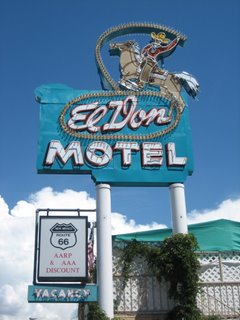 I've seen a lot more new homes go up, more shopping areas and a revitalized downtown, and some local attractions that have been added. It's a funny feeling to go to a city for one day a year: you feel familiar and attached to the place yet you don't get enough time to soak up the daily culture and relationships. Albuquerque is along the famous "Route 66" which was the main route to the West before the Interstate Highway system was created. Plenty of kitschy motels lined the "Mother Road" with eccentric designs local to the area. Here you can see the "El Don" motel as a salute to the Spanish Conquistadors and American Cowboys who roamed the Wild West.
The city has a high population of Hispanic and Indigenous people. One of my favorite places to visit is a barber shop that still gives "shave and a haircut" treatment to its customers.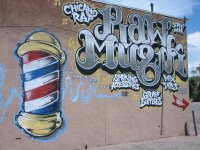 Men may not go to a beauty salon, but they still need some pampering in the form of steaming hot towels and a straight-razor shave. Have a cut so close that you don't need to shave for two days is quite a luxury for those who otherwise have to shave daily! Also nearby is Old Town, where original Adobe-style buildings survive from the 17th century. Most people don't realize that while the English colonies were just getting started on the East Coast, Spanish colonies were thriving in the southwest. With four centuries of Spanish heritage here, is it really a wonder that there are so many Spanish speakers here?
On Sunday I traveled up to Santa Fe to visit the local art museum.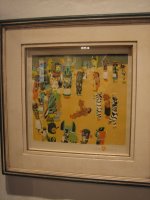 It features a few pieces by Georgia O'Keefe, whose watercolors reflect the soft pastels of the desert landscape. Most of her works are in the eponymous museum, also located in Santa Fe. Also on display were some woodblock prints from an artist in the 1930s when times were tough and the government sponsored public works projects to employ artists, boost morale, and document local culture. Santa Fe, and Taos further North, host thriving artist communities that make for a very interesting visit.
I knew I would be in for a disappointment when I decided to take the train from ABQ to LA. Having experienced the Japanese train system in all its grandeur, I figured that I should try out Amtrak just to have a fresh experience to compare it with.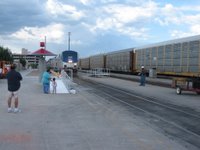 It started with the train arriving 90 minutes late. This happens so frequently that Amtrak has programmed its customer service phone number to feature "train status" as its first option. I had called earlier in the day to check, so I knew this, and got to the station about 20 minutes before the train arrived. Japan's trains are mostly one level, run by electricity, and compact; Amtrak has gargantuan double-decker cars powered by diesel locomotives. More train, more to maintain. Shortly after I boarded the train, the lights went out and the A/C stopped blowing. This would be the beginning of a 3-hour delay to replace a bad engine. I don't mind the train being late or going slowly as much as I mind sitting on a train in the high desert that isn't moving when it's supposed to. My hopes to see the beautiful desert landscape at sunset were dashed as night fell and we still hadn't left the station.
Thanks to my sleeping mask and inflatable pillow, I was able to get some sleep through the night. I woke up at first light and watched the sunrise over Western Arizona. There's something about the barren desert that sets your mind to wander up to the soft blue sky for comfort. I got to thinking about my job and life prospects in LA which hadn't come together yet. Then I started reading some children's books to take my mind off questions that I didn't have answers for yet.
After almost 21 hours on the train, I arrived in Los Angeles. The slow way to go (trains) really needs an investment boost to become a viable alternative to airplane travel. Many train trips are marketed in the USA as preserving the "golden age" of train travel: luxurious dining, sleeping cars, and steam engines. Other people love trains, warts and all: I saw a few train buffs on my trip who had scanners to monitor the communications between engineers. The USA uses commuter trains pretty well, but intercity travel doesn't really compete with airplanes. It can. I've seen it in Japan. I will be closely following the developments of the California High Speed Rail Authority to build a bullet train between SF, LA, and Sacramento by 2020. Only 55 years after Japan. There ARE things the USA isn't the first and best in. Check it out.
A week after I arrived in LA, I went to Albuquerque, New Mexico for some church business. I've been going there for an annual conference since 1999, so every year I get to track the changes in the town.
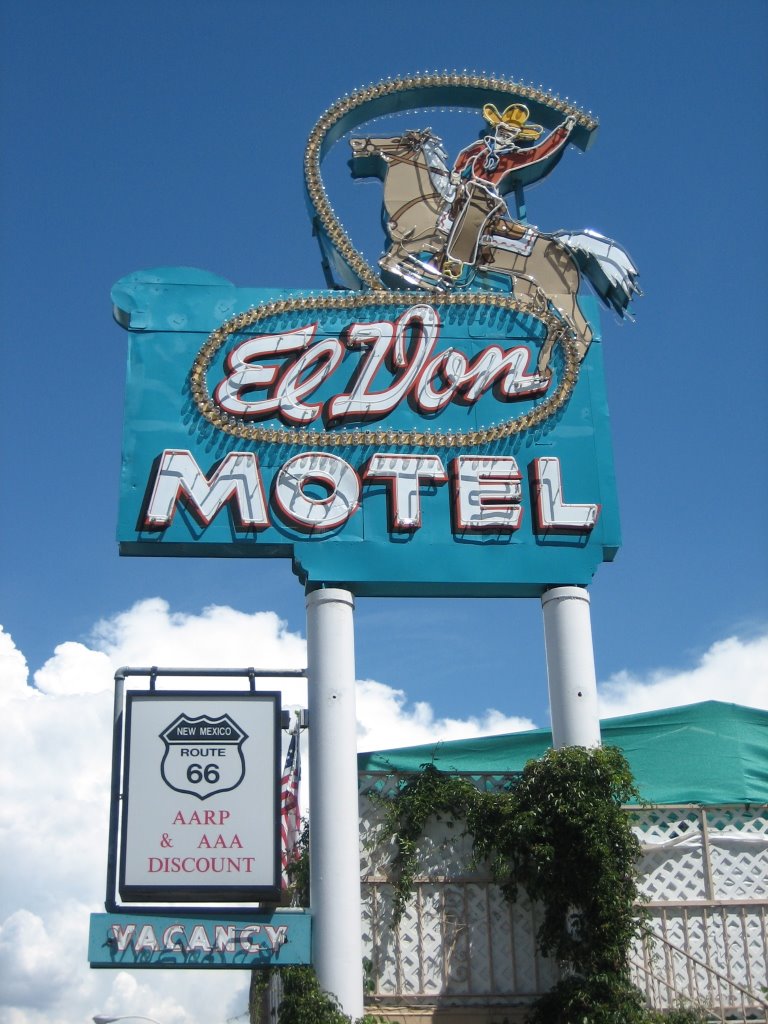 I've seen a lot more new homes go up, more shopping areas and a revitalized downtown, and some local attractions that have been added. It's a funny feeling to go to a city for one day a year: you feel familiar and attached to the place yet you don't get enough time to soak up the daily culture and relationships. Albuquerque is along the famous "Route 66" which was the main route to the West before the Interstate Highway system was created. Plenty of kitschy motels lined the "Mother Road" with eccentric designs local to the area. Here you can see the "El Don" motel as a salute to the Spanish Conquistadors and American Cowboys who roamed the Wild West.
The city has a high population of Hispanic and Indigenous people. One of my favorite places to visit is a barber shop that still gives "shave and a haircut" treatment to its customers.
 Men may not go to a beauty salon, but they still need some pampering in the form of steaming hot towels and a straight-razor shave. Have a cut so close that you don't need to shave for two days is quite a luxury for those who otherwise have to shave daily! Also nearby is Old Town, where original Adobe-style buildings survive from the 17th century. Most people don't realize that while the English colonies were just getting started on the East Coast, Spanish colonies were thriving in the southwest. With four centuries of Spanish heritage here, is it really a wonder that there are so many Spanish speakers here?
On Sunday I traveled up to Santa Fe to visit the local art museum.
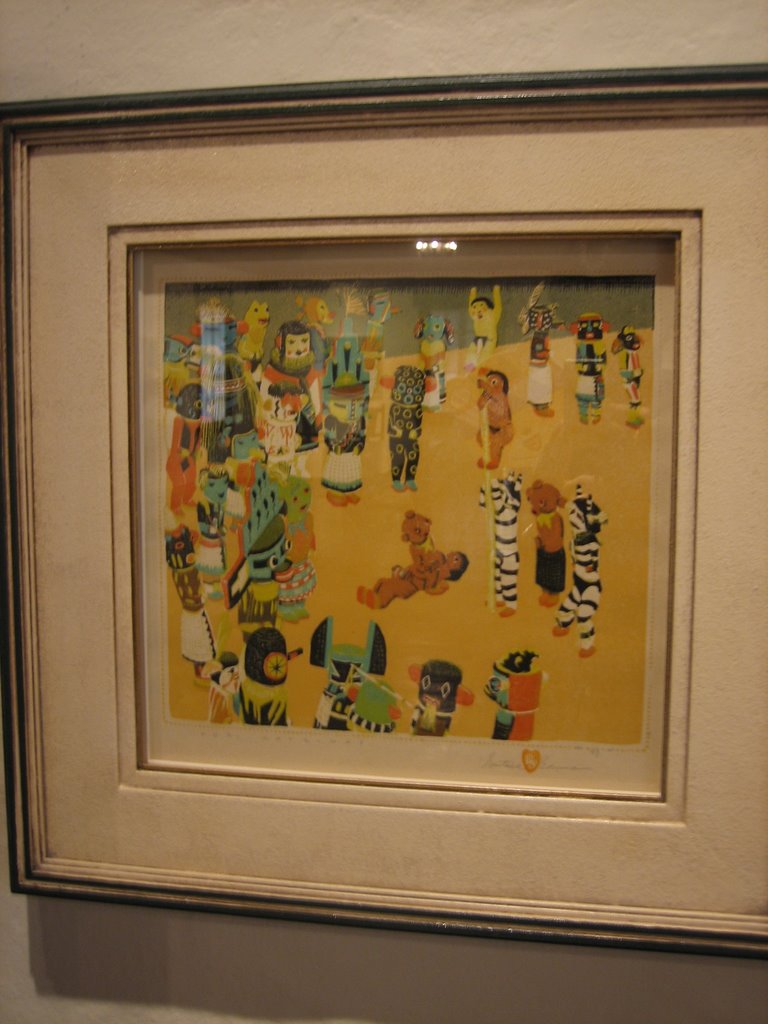 It features a few pieces by Georgia O'Keefe, whose watercolors reflect the soft pastels of the desert landscape. Most of her works are in the eponymous museum, also located in Santa Fe. Also on display were some woodblock prints from an artist in the 1930s when times were tough and the government sponsored public works projects to employ artists, boost morale, and document local culture. Santa Fe, and Taos further North, host thriving artist communities that make for a very interesting visit.
I knew I would be in for a disappointment when I decided to take the train from ABQ to LA. Having experienced the Japanese train system in all its grandeur, I figured that I should try out Amtrak just to have a fresh experience to compare it with.
 It started with the train arriving 90 minutes late. This happens so frequently that Amtrak has programmed its customer service phone number to feature "train status" as its first option. I had called earlier in the day to check, so I knew this, and got to the station about 20 minutes before the train arrived. Japan's trains are mostly one level, run by electricity, and compact; Amtrak has gargantuan double-decker cars powered by diesel locomotives. More train, more to maintain. Shortly after I boarded the train, the lights went out and the A/C stopped blowing. This would be the beginning of a 3-hour delay to replace a bad engine. I don't mind the train being late or going slowly as much as I mind sitting on a train in the high desert that isn't moving when it's supposed to. My hopes to see the beautiful desert landscape at sunset were dashed as night fell and we still hadn't left the station.
Thanks to my sleeping mask and inflatable pillow, I was able to get some sleep through the night. I woke up at first light and watched the sunrise over Western Arizona. There's something about the barren desert that sets your mind to wander up to the soft blue sky for comfort. I got to thinking about my job and life prospects in LA which hadn't come together yet. Then I started reading some children's books to take my mind off questions that I didn't have answers for yet.
After almost 21 hours on the train, I arrived in Los Angeles. The slow way to go (trains) really needs an investment boost to become a viable alternative to airplane travel. Many train trips are marketed in the USA as preserving the "golden age" of train travel: luxurious dining, sleeping cars, and steam engines. Other people love trains, warts and all: I saw a few train buffs on my trip who had scanners to monitor the communications between engineers. The USA uses commuter trains pretty well, but intercity travel doesn't really compete with airplanes. It can. I've seen it in Japan. I will be closely following the developments of the California High Speed Rail Authority to build a bullet train between SF, LA, and Sacramento by 2020. Only 55 years after Japan. There ARE things the USA isn't the first and best in. Check it out.
8.25.2006
Hawaiian Respite

It has been almost 3 weeks since I have arrived back in the USA for good. But I have yet to dedicate a blog entry to what I've done here. Perhaps I am trying to figure out how to keep up this web journal without the obvious prompts of adjusting to another culture. Seeing one's own culture with an outsider's perspective gives valuable insight. Or is it just reverse culture shock? That's what I'm trying to figure out.
I planned my flight back with layovers in Busan, South Korea; Tokyo, Japan; and Honolulu, Hawaii, USA. My school, which graciously paid for my ticket, complained that I had such an indirect route but that was actually the cheapest ticket. A 12-hour layover in Honolulu... ok, I'll take it! Hawaii is a meeting point of East and West. The plurality of cultures there ensured that I wouldn't get the full "American" immersion for one more day. I needed to ease myself back into America.
It helps when I have family over there that I can hang out with. Stephen, my cousin, is a mechanic for a cargo airline that shuttles fish and mail to and from the tiny islands between Hawaii and Guam. His father was born in New York, his mother in Hiroshima, Japan, so he is half Japanese. His wife, Yumiko, is from Tokyo, so their four children are three-quarters Japanese. Staying with them when I left for, and came back from, Japan made for a gentle transition. We ate sashimi, fried rice, and edamame as I showed them pictures of my time there. They were impressed with how much Japanese I had learned while I was over there (I'm surprised at how quickly I think I've lost it since returning!).
What else do you do with family in Hawaii but go to the beach at sunset?! We piled into two cars and set off for Haleiwa Beach. All the way we chatted about our growth during the past year. At the beach, I played with the two youngest in the water while the college aged Jarel and Sara watched from the sand. Sara studies broadcast journalism at Hawaii Pacific University. She offered to take my camera and photos of the event. So the credit for the photos goes to her.
As the sun set and the evening cooled off, we drove back home. My flight would leave in 2 hours. Yumiko and I talked about what I missed and didn't like about Japan. I missed the food, I didn't like having to anticipate what other people were thinking. I have enough trouble figuring out what I think. I missed the public courtesy and customer service. I missed people who made sure they were taken care of by taking care of other people.
The overnight flight to Los Angeles gave me little chance for comfort or sleep. Japan Airlines fed me twice and always kept me hydrated on the 8-hour flight from Tokyo to Honolulu; American Airlines gave me one drink on the 6-hour flight to LA. Welcome back.
In the coming weeks I'll be searching for an apartment, a car, a job, and a voice for my new perspective on life with deeper knowledge of an Asian culture in my worldview. I hope I can keep the tone of my blog upbeat, insightful, and free of politics and ranting.

Subscribe to:
Posts (Atom)

Countries I have visited
Where I've been in the USA
visited 44 states (88%)
Create your own visited map of The United States or Like this? try: Canned laughter