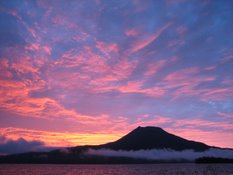
As promised, here's a story from my previous travels. It takes place in November, 1999.
There's something about realizing one's own mortality in a place, or furthermore on this Earth, that liberates him to try something exotic that he otherwise wouldn't. I realized this as a neophyte Peace Corps volunteer in Benin, West Africa.
I was training in Parakou, the gateway to the Sahel region in the North of the country. For two months, I had been negotiating for my future in the country; to have the right to pray for myself first before taking the mind-boggling anti-malarial drug should I contract the disease. Ironic, I never got sick a day while I was there. Still, I would go into town every two weeks for a phone call with the country director.
On this day, I had made a final decision: to transfer from Benin to another country's program yet to be determined. After two months of wrangling, I felt at peace. Although my time in Benin would be coming to an end, I finally felt free to enjoy my time there at it's fullest. I hung up the phone at the work station and walked outside to catch a Zemidjan. "Zeh" as they are affectionately called by locals, are scooter taxis that whisk Beninois around towns. I put on my casque, helmet, but left the visor up to catch the cool breeze as my zeh picked up speed on the western road out of Parakou.
With my mind free to reflect on the back of that scooter as I rode to the compound of my host family, I thought about my time there in Benin. How it was fraught with mental struggle to understand a new culture, included brief highlights of insight, laughter with host brothers, and fear of wild creatures and voodoo religion. The closer I got to home, the more I felt free of those limitations to my experience there.
By the time I arrived at the compound, I was like a released prisoner, given a second chance on my experience in Benin. So when there was an unusual amount of activity in the common area of the compound, I wasn't surprised that it was an extension of my new attitude. François, the teenage cousin of my host brothers, Muhammed and Fatau, was turning circles around them with what looked like a thick rope. When I got closer, we exchanged bonjou's and sa va's and I got a look at what François really had: a four-foot-long snake! It was dead, thank goodness. Muhammed and Fatau had catches of their own: two field mice.
The boys had been out working in the fields when they'd come upon this snake in the middle of ingesting a field mouse. Temporarily disabled in its gorging, the snake was vulnerable. François took his cutlass and chopped off that snake's head. What would they find not too deep in that snake's belly but another mouse. A double whammy!
Now don't think that these mice were finger length. In Africa, everything wild is so much bigger than what we imagine them to be from the comforts of our TV room in USA. These field mice were a full six inches long, not including the tail. Any catch of meat in this part of Africa was a special treat. My meals consisted mostly of pounded yams and potent soup base to dip it in. Certainly filling, but lacking in protein for sure. So when we had two kinds of fresh meat to eat, you can bet that was a treat!
Muhammed and another cousin prepared the fire, while François cleaned and gutted each creature. Fatau, about six years old with a belly rounded by vitamin deficiency, carried himself with a jollyful gait as he walked around the compound with the expectation to eat well that evening. I watched carefully has each boy set about to enjoy their feast.
How do you know when snake is boiled through? You don't. You just know how to cook something safely and then you apply to whatever mystery meat you find that day. As for field mice, Muhammed gutted them, skewered them, and then singed the hairs off them with the brightest of the flames on the fire. Then they set about cooking them shish-ke-bob style.
All the while I was savoring this moment of raw excitement and embracing of the surprises that the African earth could give up. This was the boys' feast, but I would certainly take a taste. What does snake taste like? How do you eat a mouse? Like itself, one bite at a time.
The meats were cooked and we boys sat around the dwindling light of the fire sinking our teeth into our dinner. The snake didn't break down without a dogfight in my molars. The mouse was moist, oily, and rich, almost like he came from the Nigerian soil to the East. I ate them without care for tomorrow. I ate them just savoring the experience of immersing myself in something so foreign and exotic to everything I'd grown up in, that nothing could hurt me. And nothing did. My subsequent visits to the latrine were regular and routine.
It's eight years later now. I look back on that experience with great treasure. My moment of eating in what Benin had to offer. In a month, I would board a jet plane for the States. In two, I would be in Jamaica. And another eating experience would begin.
Showing posts with label 1999. Show all posts
Showing posts with label 1999. Show all posts
2.19.2007


9.05.2006
New Mexico
Some people say that the best way to readjust to your own country is to travel again. I would say that this is just postponing the inevitable. But then again, I'm guilty of it too.
A week after I arrived in LA, I went to Albuquerque, New Mexico for some church business. I've been going there for an annual conference since 1999, so every year I get to track the changes in the town.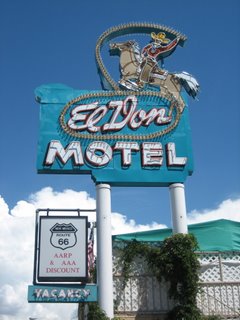 I've seen a lot more new homes go up, more shopping areas and a revitalized downtown, and some local attractions that have been added. It's a funny feeling to go to a city for one day a year: you feel familiar and attached to the place yet you don't get enough time to soak up the daily culture and relationships. Albuquerque is along the famous "Route 66" which was the main route to the West before the Interstate Highway system was created. Plenty of kitschy motels lined the "Mother Road" with eccentric designs local to the area. Here you can see the "El Don" motel as a salute to the Spanish Conquistadors and American Cowboys who roamed the Wild West.
The city has a high population of Hispanic and Indigenous people. One of my favorite places to visit is a barber shop that still gives "shave and a haircut" treatment to its customers. Men may not go to a beauty salon, but they still need some pampering in the form of steaming hot towels and a straight-razor shave. Have a cut so close that you don't need to shave for two days is quite a luxury for those who otherwise have to shave daily! Also nearby is Old Town, where original Adobe-style buildings survive from the 17th century. Most people don't realize that while the English colonies were just getting started on the East Coast, Spanish colonies were thriving in the southwest. With four centuries of Spanish heritage here, is it really a wonder that there are so many Spanish speakers here?
On Sunday I traveled up to Santa Fe to visit the local art museum. It features a few pieces by Georgia O'Keefe, whose watercolors reflect the soft pastels of the desert landscape. Most of her works are in the eponymous museum, also located in Santa Fe. Also on display were some woodblock prints from an artist in the 1930s when times were tough and the government sponsored public works projects to employ artists, boost morale, and document local culture. Santa Fe, and Taos further North, host thriving artist communities that make for a very interesting visit.
I knew I would be in for a disappointment when I decided to take the train from ABQ to LA. Having experienced the Japanese train system in all its grandeur, I figured that I should try out Amtrak just to have a fresh experience to compare it with.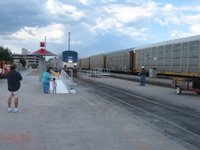 It started with the train arriving 90 minutes late. This happens so frequently that Amtrak has programmed its customer service phone number to feature "train status" as its first option. I had called earlier in the day to check, so I knew this, and got to the station about 20 minutes before the train arrived. Japan's trains are mostly one level, run by electricity, and compact; Amtrak has gargantuan double-decker cars powered by diesel locomotives. More train, more to maintain. Shortly after I boarded the train, the lights went out and the A/C stopped blowing. This would be the beginning of a 3-hour delay to replace a bad engine. I don't mind the train being late or going slowly as much as I mind sitting on a train in the high desert that isn't moving when it's supposed to. My hopes to see the beautiful desert landscape at sunset were dashed as night fell and we still hadn't left the station.
Thanks to my sleeping mask and inflatable pillow, I was able to get some sleep through the night. I woke up at first light and watched the sunrise over Western Arizona. There's something about the barren desert that sets your mind to wander up to the soft blue sky for comfort. I got to thinking about my job and life prospects in LA which hadn't come together yet. Then I started reading some children's books to take my mind off questions that I didn't have answers for yet.
After almost 21 hours on the train, I arrived in Los Angeles. The slow way to go (trains) really needs an investment boost to become a viable alternative to airplane travel. Many train trips are marketed in the USA as preserving the "golden age" of train travel: luxurious dining, sleeping cars, and steam engines. Other people love trains, warts and all: I saw a few train buffs on my trip who had scanners to monitor the communications between engineers. The USA uses commuter trains pretty well, but intercity travel doesn't really compete with airplanes. It can. I've seen it in Japan. I will be closely following the developments of the California High Speed Rail Authority to build a bullet train between SF, LA, and Sacramento by 2020. Only 55 years after Japan. There ARE things the USA isn't the first and best in. Check it out.
A week after I arrived in LA, I went to Albuquerque, New Mexico for some church business. I've been going there for an annual conference since 1999, so every year I get to track the changes in the town.
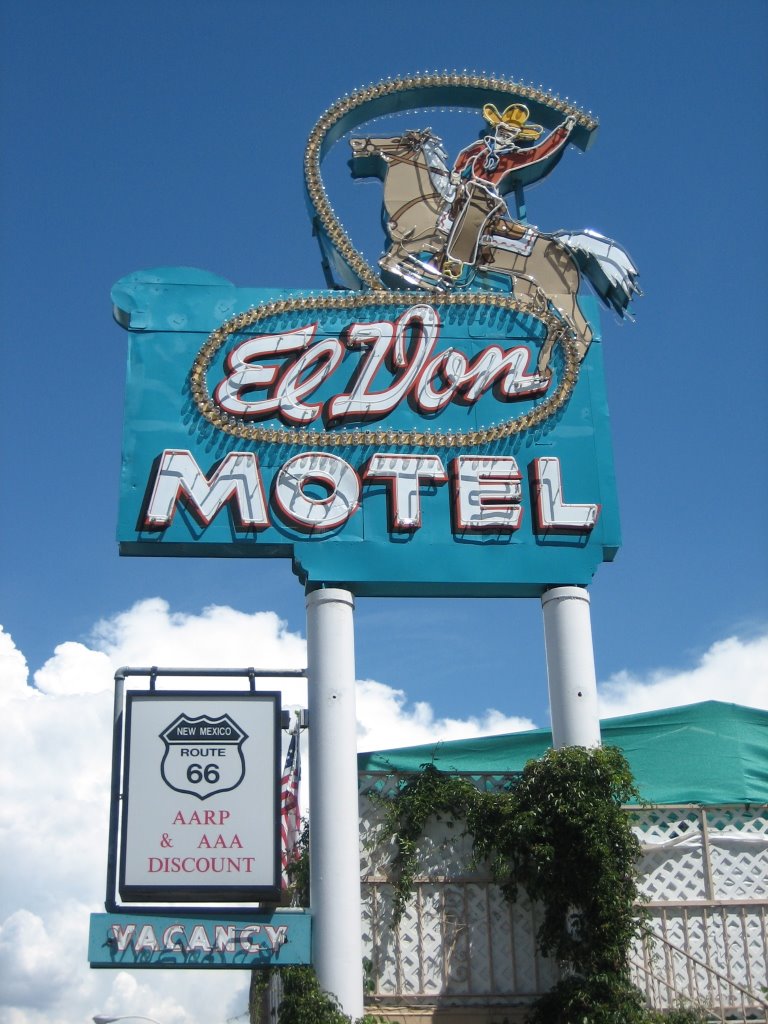 I've seen a lot more new homes go up, more shopping areas and a revitalized downtown, and some local attractions that have been added. It's a funny feeling to go to a city for one day a year: you feel familiar and attached to the place yet you don't get enough time to soak up the daily culture and relationships. Albuquerque is along the famous "Route 66" which was the main route to the West before the Interstate Highway system was created. Plenty of kitschy motels lined the "Mother Road" with eccentric designs local to the area. Here you can see the "El Don" motel as a salute to the Spanish Conquistadors and American Cowboys who roamed the Wild West.
The city has a high population of Hispanic and Indigenous people. One of my favorite places to visit is a barber shop that still gives "shave and a haircut" treatment to its customers.
 Men may not go to a beauty salon, but they still need some pampering in the form of steaming hot towels and a straight-razor shave. Have a cut so close that you don't need to shave for two days is quite a luxury for those who otherwise have to shave daily! Also nearby is Old Town, where original Adobe-style buildings survive from the 17th century. Most people don't realize that while the English colonies were just getting started on the East Coast, Spanish colonies were thriving in the southwest. With four centuries of Spanish heritage here, is it really a wonder that there are so many Spanish speakers here?
On Sunday I traveled up to Santa Fe to visit the local art museum.
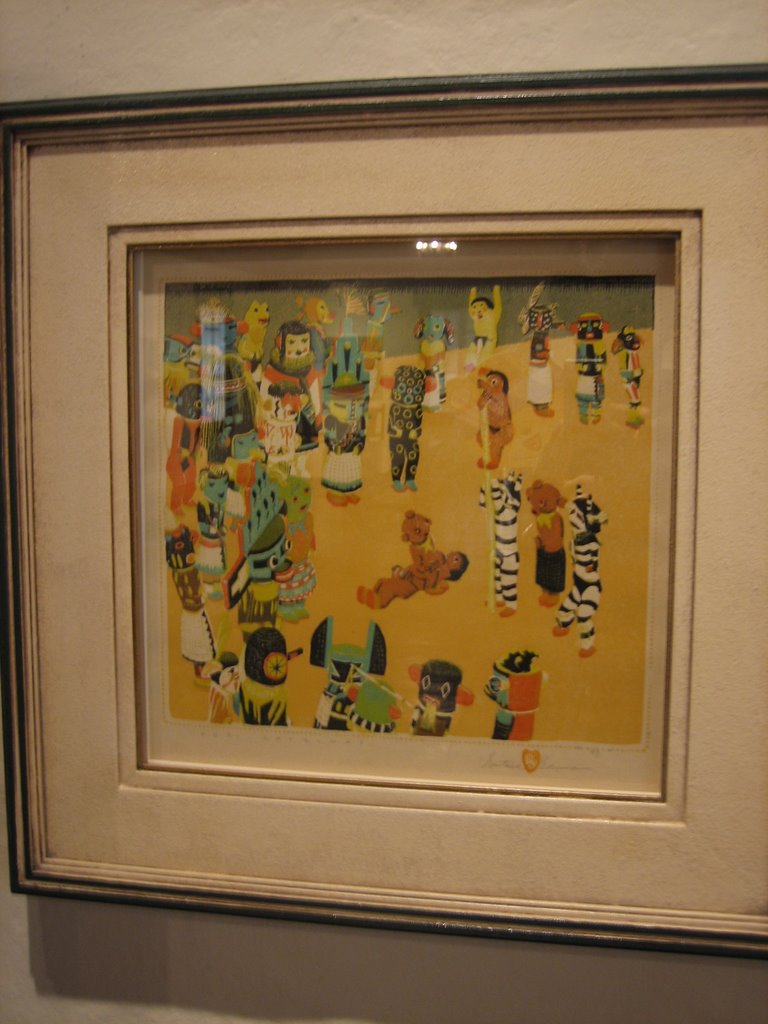 It features a few pieces by Georgia O'Keefe, whose watercolors reflect the soft pastels of the desert landscape. Most of her works are in the eponymous museum, also located in Santa Fe. Also on display were some woodblock prints from an artist in the 1930s when times were tough and the government sponsored public works projects to employ artists, boost morale, and document local culture. Santa Fe, and Taos further North, host thriving artist communities that make for a very interesting visit.
I knew I would be in for a disappointment when I decided to take the train from ABQ to LA. Having experienced the Japanese train system in all its grandeur, I figured that I should try out Amtrak just to have a fresh experience to compare it with.
 It started with the train arriving 90 minutes late. This happens so frequently that Amtrak has programmed its customer service phone number to feature "train status" as its first option. I had called earlier in the day to check, so I knew this, and got to the station about 20 minutes before the train arrived. Japan's trains are mostly one level, run by electricity, and compact; Amtrak has gargantuan double-decker cars powered by diesel locomotives. More train, more to maintain. Shortly after I boarded the train, the lights went out and the A/C stopped blowing. This would be the beginning of a 3-hour delay to replace a bad engine. I don't mind the train being late or going slowly as much as I mind sitting on a train in the high desert that isn't moving when it's supposed to. My hopes to see the beautiful desert landscape at sunset were dashed as night fell and we still hadn't left the station.
Thanks to my sleeping mask and inflatable pillow, I was able to get some sleep through the night. I woke up at first light and watched the sunrise over Western Arizona. There's something about the barren desert that sets your mind to wander up to the soft blue sky for comfort. I got to thinking about my job and life prospects in LA which hadn't come together yet. Then I started reading some children's books to take my mind off questions that I didn't have answers for yet.
After almost 21 hours on the train, I arrived in Los Angeles. The slow way to go (trains) really needs an investment boost to become a viable alternative to airplane travel. Many train trips are marketed in the USA as preserving the "golden age" of train travel: luxurious dining, sleeping cars, and steam engines. Other people love trains, warts and all: I saw a few train buffs on my trip who had scanners to monitor the communications between engineers. The USA uses commuter trains pretty well, but intercity travel doesn't really compete with airplanes. It can. I've seen it in Japan. I will be closely following the developments of the California High Speed Rail Authority to build a bullet train between SF, LA, and Sacramento by 2020. Only 55 years after Japan. There ARE things the USA isn't the first and best in. Check it out.
Subscribe to:
Posts (Atom)

Countries I have visited
Where I've been in the USA
visited 44 states (88%)
Create your own visited map of The United States or Like this? try: Canned laughter